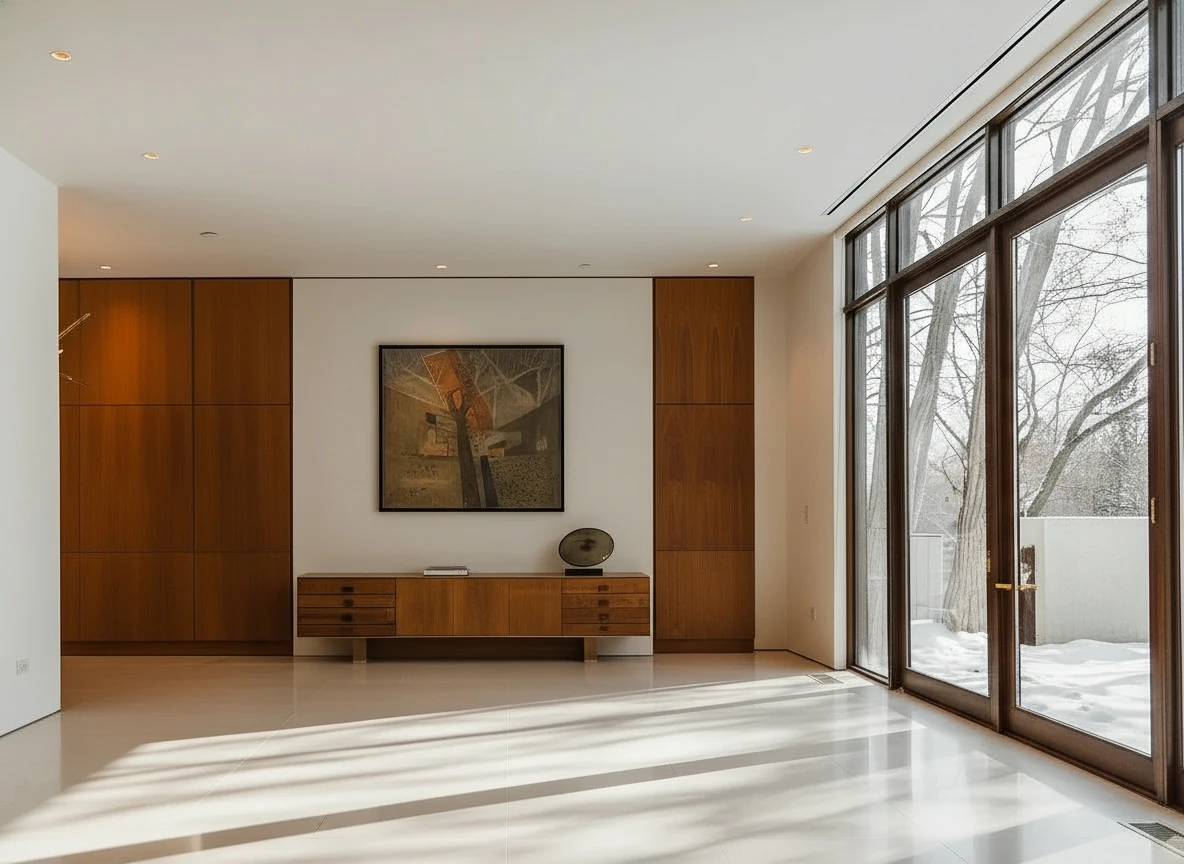
Create a photo of the same living room, virtually staged in a Modern style. Add a sleek white sofa to the right side of the photo, a minimalist coffee table in the center of the room, a large abstract art piece on the main wall, and some indoor plants.
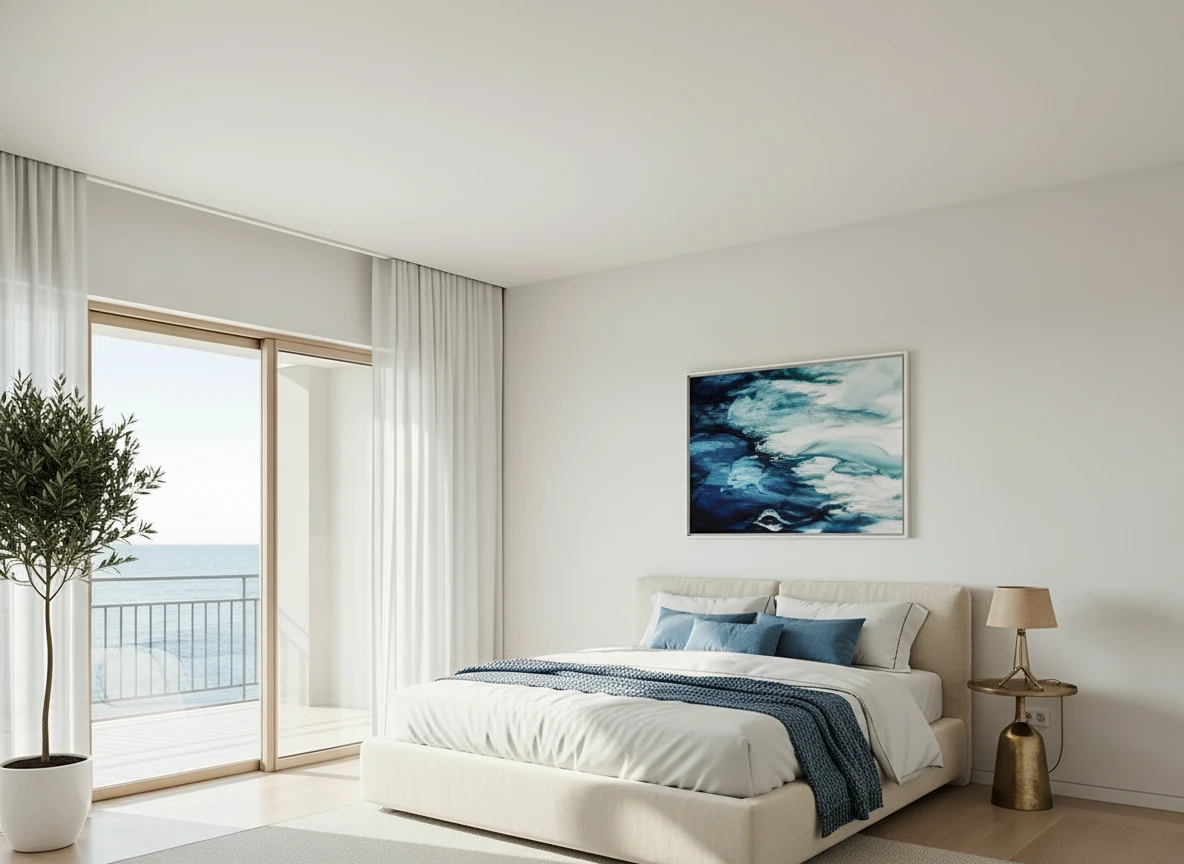
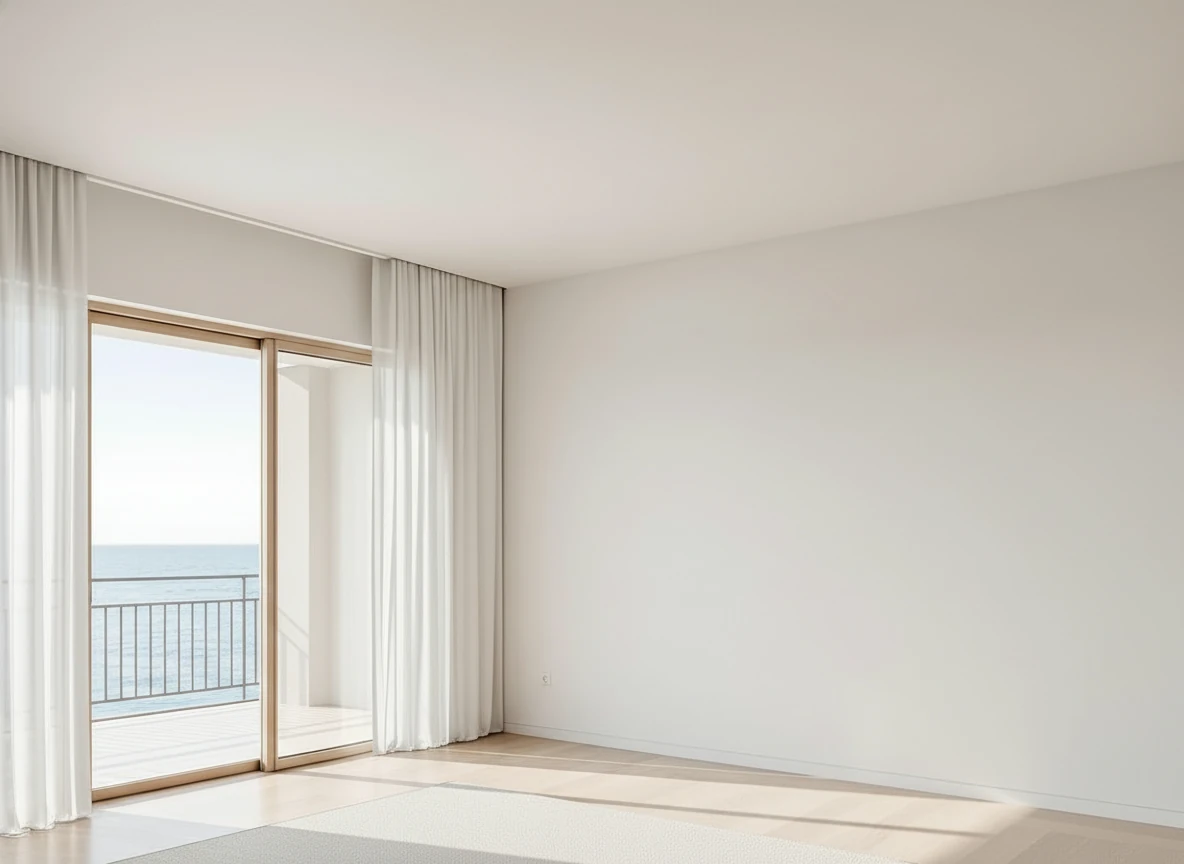
Furnish the serene bedroom with a low-profile cream platform bed centered on a large textured beige rug. Dress the bed in white linens with a soft blue throw and matching accent pillows for contrast. Place a tall potted olive tree in a white planter beside the sliding glass doors, and a small brass bedside lamp on the right. Hang a framed ocean-themed artwork above the bed to echo the seaside view. Keep floor-to-ceiling white curtains along the balcony doors, light wood flooring, and minimal decor to maintain an airy, coastal feel.
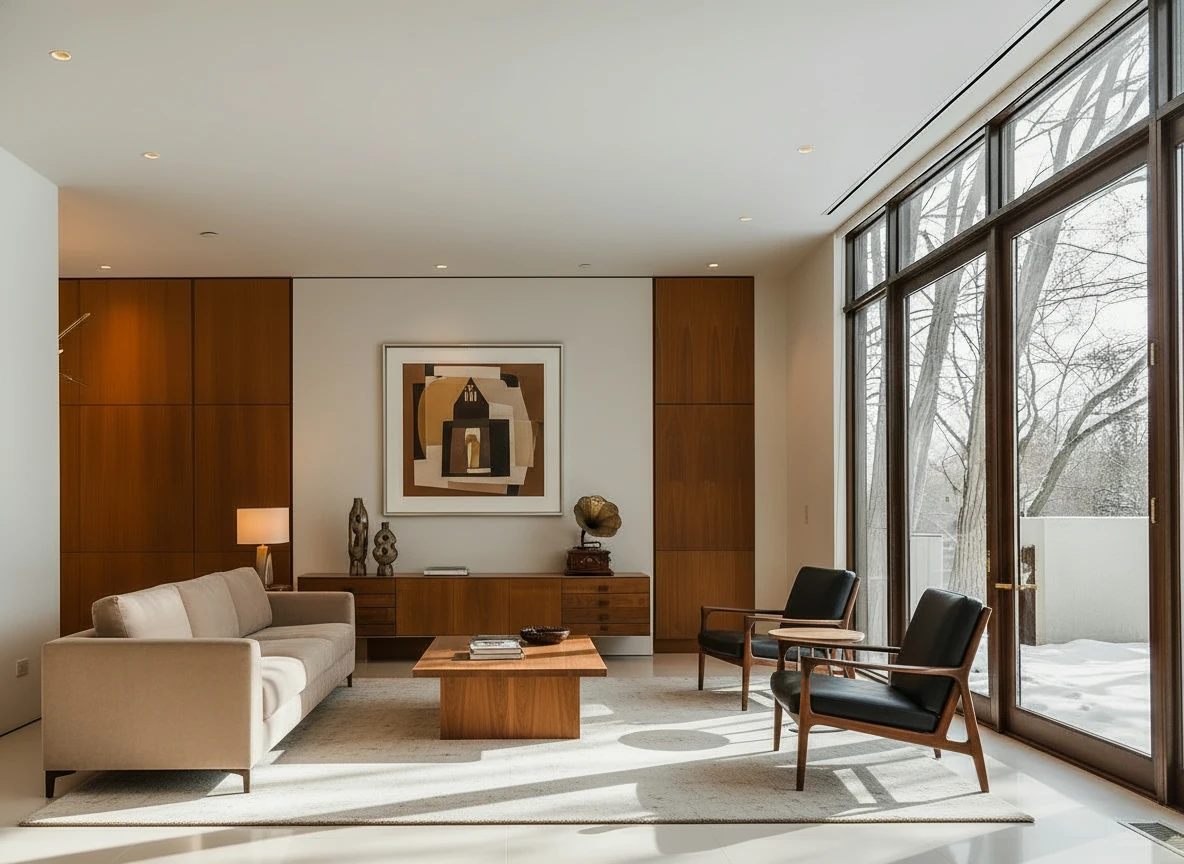
Furnish the room with a long beige sofa on the left facing a rectangular walnut coffee table (1.6m × 0.8m) centered on a light cream rug. Add two black leather lounge chairs with wooden frames opposite the sofa, one angled toward the windows. Behind, place a low walnut sideboard spanning the width between two tall built-in wood panels, decorated with sculptural vases and a gramophone. Mount a large abstract artwork above the sideboard. Finish with a warm table lamp on the side table near the sofa, soft downlights, and full-height glass doors along the right wall. Make sure the placement of furnitures are reasonable based on the room layout
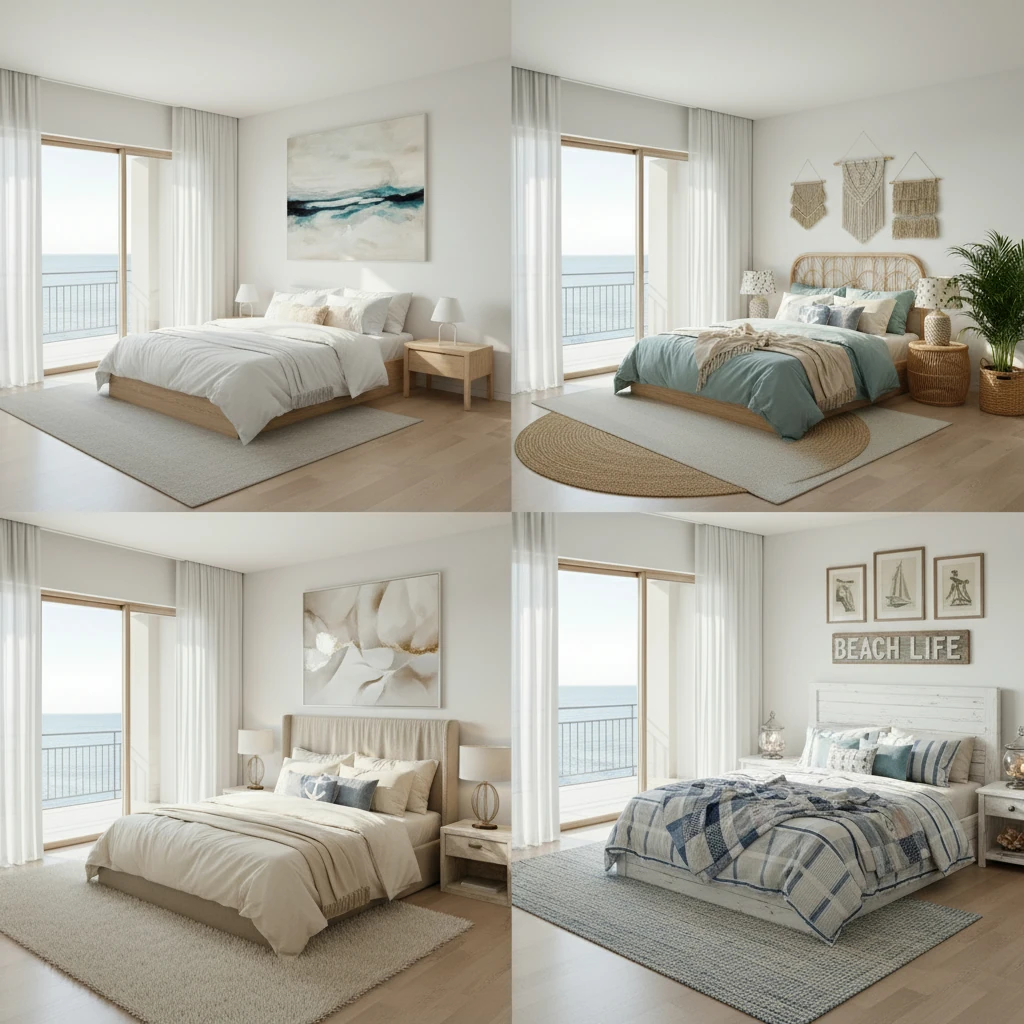
Furnish the bedroom with a bed and additional furniture and decorations, and create a 2x2 image showing four variations of the same coastal bedroom in different interior design styles. Use consistent room layout and lighting, but vary textures, furniture, and decor to reflect each style. The four styles are:
	1.	Modern Coastal – light oak wood, white linen bedding, minimal decor, ocean-inspired art.
	2.	Bohemian Coastal – rattan furniture, layered textiles, soft blue-green palette, plants and woven accents.
	3.	Luxury Coastal – high-end finishes, soft beige and ivory tones, marble nightstands, large windows with seaside view.
	4.	Rustic Beach Cottage – weathered wood furniture, nautical elements, striped bedding, casual cozy feel.

Include natural daylight, soft shadows, and an airy seaside atmosphere. Keep the room window/building structure unchanged in all variations
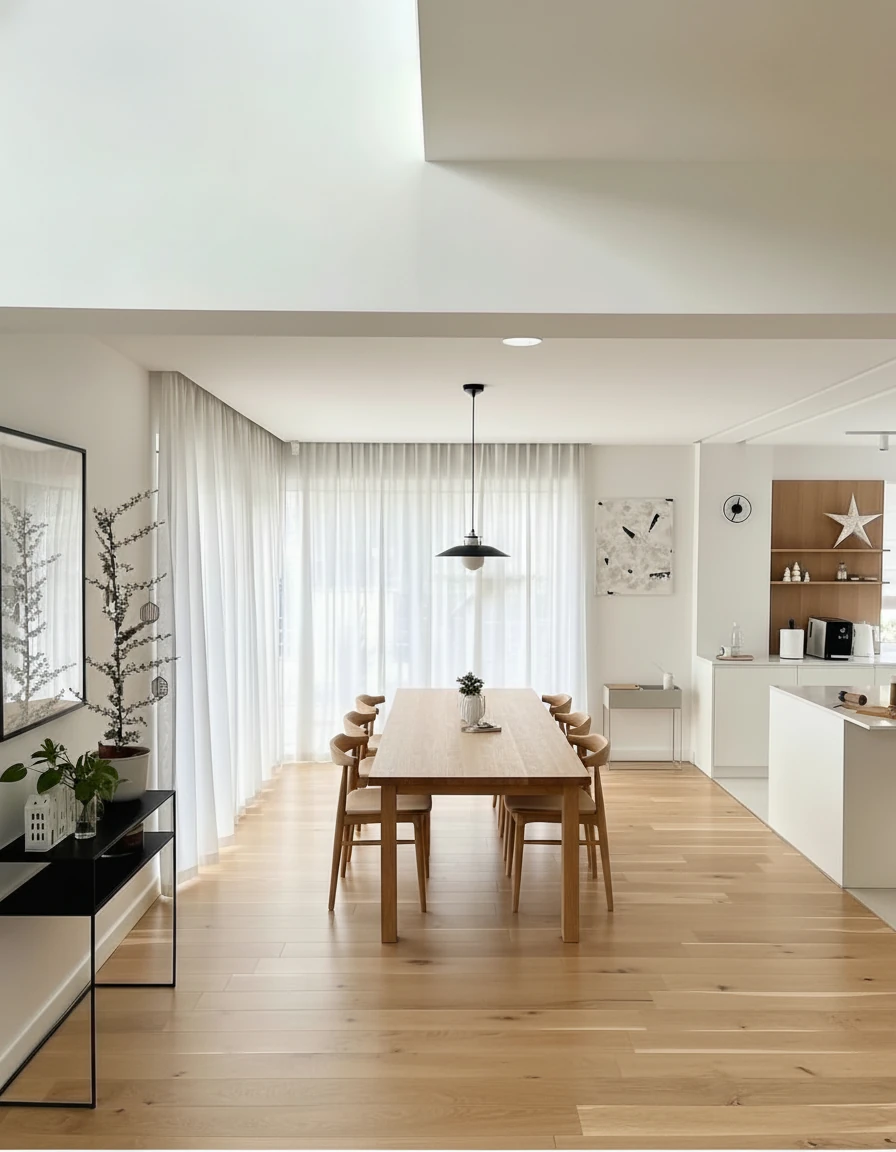
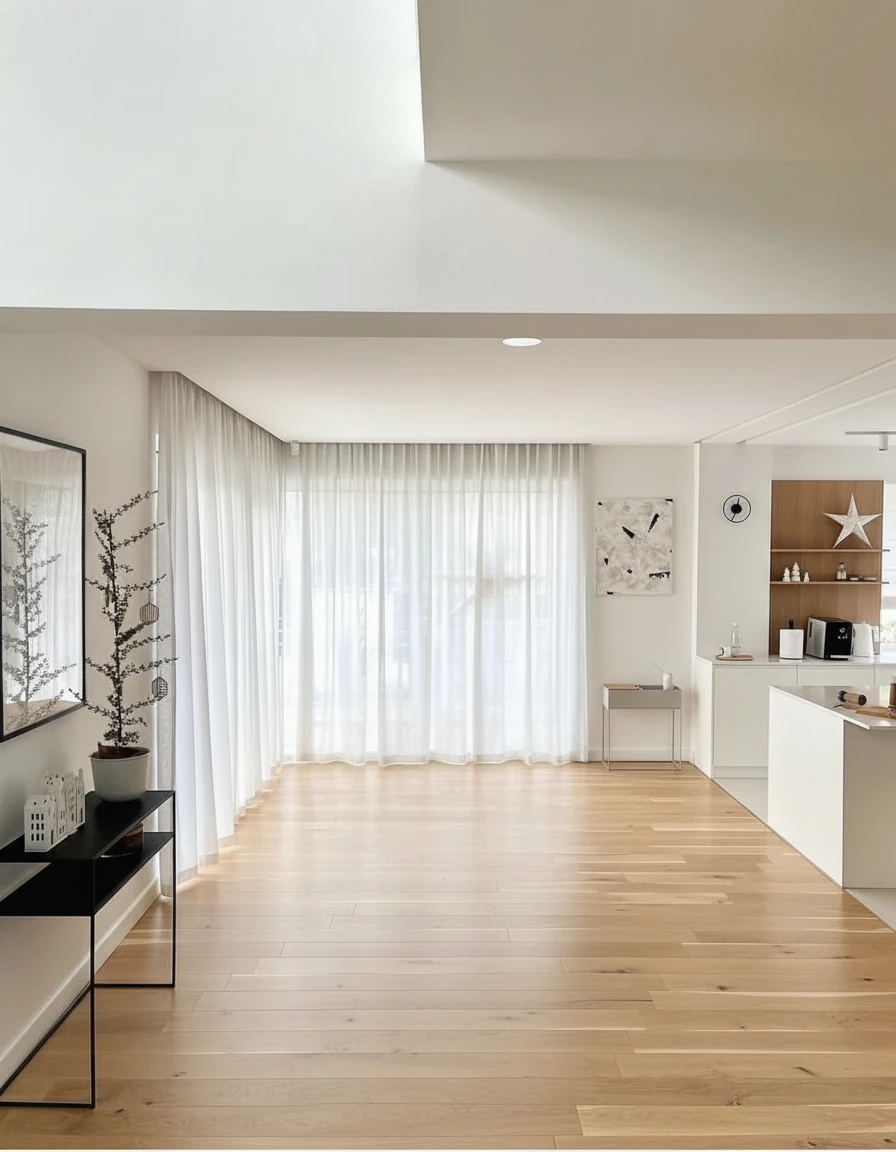
Furnish the dining area with a long natural oak dining table (3m × 1m) centered on the wooden floor, surrounded by eight matching curved-back oak chairs. Above the table, install a pair of minimalist black-and-white pendant lights aligned along the centerline. Add sheer white curtains across the full window wall for soft daylight diffusion. Place a slim black console with potted plants and small decor on the left wall, and keep the adjoining kitchen open with white cabinetry and oak shelving for a warm, cohesive look.
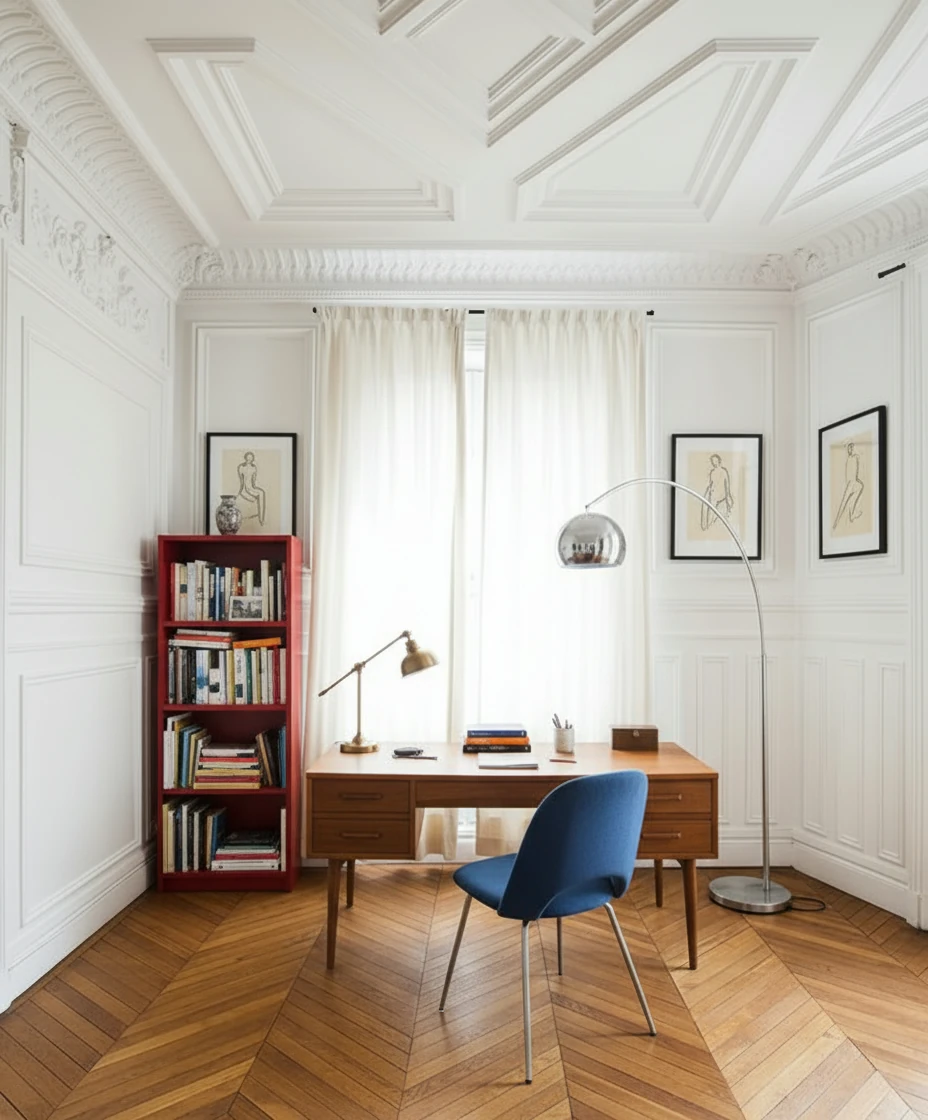
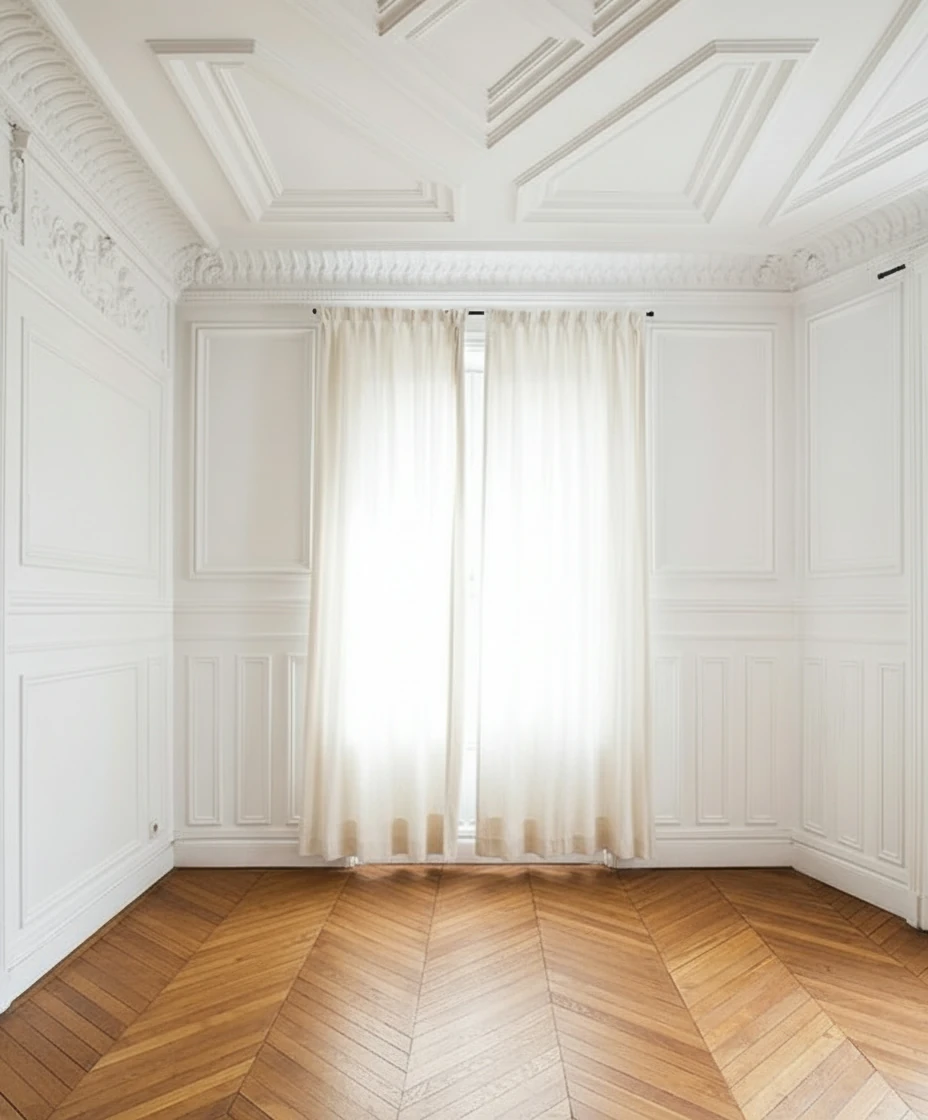
Furnish the study with a mid-century wooden desk centered in front of tall, cream-draped windows, paired with a blue-upholstered chair featuring metal legs. Place a vintage desk lamp and neatly arranged books and stationery on the desk. To the left, add a red open bookshelf filled with books and decorative objects. Include a tall arched chrome floor lamp curving over the desk for dramatic lighting. Hang two framed figure drawings symmetrically on either side of the window. Keep the ornate white paneled walls and chevron wood floor exposed for a refined Parisian atmosphere.
Create a photo of the same living room, virtually staged in a Modern style. Add a sleek white sofa to the right side of the photo, a minimalist coffee table in the center of the room, a large abstract art piece on the main wall, and some indoor plants.
Furnish the serene bedroom with a low-profile cream platform bed centered on a large textured beige rug. Dress the bed in white linens with a soft blue throw and matching accent pillows for contrast. Place a tall potted olive tree in a white planter beside the sliding glass doors, and a small brass bedside lamp on the right. Hang a framed ocean-themed artwork above the bed to echo the seaside view. Keep floor-to-ceiling white curtains along the balcony doors, light wood flooring, and minimal decor to maintain an airy, coastal feel.
Furnish the room with a long beige sofa on the left facing a rectangular walnut coffee table (1.6m × 0.8m) centered on a light cream rug. Add two black leather lounge chairs with wooden frames opposite the sofa, one angled toward the windows. Behind, place a low walnut sideboard spanning the width between two tall built-in wood panels, decorated with sculptural vases and a gramophone. Mount a large abstract artwork above the sideboard. Finish with a warm table lamp on the side table near the sofa, soft downlights, and full-height glass doors along the right wall. Make sure the placement of furnitures are reasonable based on the room layout
Furnish the bedroom with a bed and additional furniture and decorations, and create a 2x2 image showing four variations of the same coastal bedroom in different interior design styles. Use consistent room layout and lighting, but vary textures, furniture, and decor to reflect each style. The four styles are:
	1.	Modern Coastal – light oak wood, white linen bedding, minimal decor, ocean-inspired art.
	2.	Bohemian Coastal – rattan furniture, layered textiles, soft blue-green palette, plants and woven accents.
	3.	Luxury Coastal – high-end finishes, soft beige and ivory tones, marble nightstands, large windows with seaside view.
	4.	Rustic Beach Cottage – weathered wood furniture, nautical elements, striped bedding, casual cozy feel.

Include natural daylight, soft shadows, and an airy seaside atmosphere. Keep the room window/building structure unchanged in all variations
Furnish the dining area with a long natural oak dining table (3m × 1m) centered on the wooden floor, surrounded by eight matching curved-back oak chairs. Above the table, install a pair of minimalist black-and-white pendant lights aligned along the centerline. Add sheer white curtains across the full window wall for soft daylight diffusion. Place a slim black console with potted plants and small decor on the left wall, and keep the adjoining kitchen open with white cabinetry and oak shelving for a warm, cohesive look.
Furnish the study with a mid-century wooden desk centered in front of tall, cream-draped windows, paired with a blue-upholstered chair featuring metal legs. Place a vintage desk lamp and neatly arranged books and stationery on the desk. To the left, add a red open bookshelf filled with books and decorative objects. Include a tall arched chrome floor lamp curving over the desk for dramatic lighting. Hang two framed figure drawings symmetrically on either side of the window. Keep the ornate white paneled walls and chevron wood floor exposed for a refined Parisian atmosphere.
Create a photo of the same living room, virtually staged in a Modern style. Add a sleek white sofa to the right side of the photo, a minimalist coffee table in the center of the room, a large abstract art piece on the main wall, and some indoor plants.
Furnish the serene bedroom with a low-profile cream platform bed centered on a large textured beige rug. Dress the bed in white linens with a soft blue throw and matching accent pillows for contrast. Place a tall potted olive tree in a white planter beside the sliding glass doors, and a small brass bedside lamp on the right. Hang a framed ocean-themed artwork above the bed to echo the seaside view. Keep floor-to-ceiling white curtains along the balcony doors, light wood flooring, and minimal decor to maintain an airy, coastal feel.
Furnish the room with a long beige sofa on the left facing a rectangular walnut coffee table (1.6m × 0.8m) centered on a light cream rug. Add two black leather lounge chairs with wooden frames opposite the sofa, one angled toward the windows. Behind, place a low walnut sideboard spanning the width between two tall built-in wood panels, decorated with sculptural vases and a gramophone. Mount a large abstract artwork above the sideboard. Finish with a warm table lamp on the side table near the sofa, soft downlights, and full-height glass doors along the right wall. Make sure the placement of furnitures are reasonable based on the room layout
Furnish the bedroom with a bed and additional furniture and decorations, and create a 2x2 image showing four variations of the same coastal bedroom in different interior design styles. Use consistent room layout and lighting, but vary textures, furniture, and decor to reflect each style. The four styles are:
	1.	Modern Coastal – light oak wood, white linen bedding, minimal decor, ocean-inspired art.
	2.	Bohemian Coastal – rattan furniture, layered textiles, soft blue-green palette, plants and woven accents.
	3.	Luxury Coastal – high-end finishes, soft beige and ivory tones, marble nightstands, large windows with seaside view.
	4.	Rustic Beach Cottage – weathered wood furniture, nautical elements, striped bedding, casual cozy feel.

Include natural daylight, soft shadows, and an airy seaside atmosphere. Keep the room window/building structure unchanged in all variations
Furnish the dining area with a long natural oak dining table (3m × 1m) centered on the wooden floor, surrounded by eight matching curved-back oak chairs. Above the table, install a pair of minimalist black-and-white pendant lights aligned along the centerline. Add sheer white curtains across the full window wall for soft daylight diffusion. Place a slim black console with potted plants and small decor on the left wall, and keep the adjoining kitchen open with white cabinetry and oak shelving for a warm, cohesive look.
Furnish the study with a mid-century wooden desk centered in front of tall, cream-draped windows, paired with a blue-upholstered chair featuring metal legs. Place a vintage desk lamp and neatly arranged books and stationery on the desk. To the left, add a red open bookshelf filled with books and decorative objects. Include a tall arched chrome floor lamp curving over the desk for dramatic lighting. Hang two framed figure drawings symmetrically on either side of the window. Keep the ornate white paneled walls and chevron wood floor exposed for a refined Parisian atmosphere.
Create a photo of the same living room, virtually staged in a Modern style. Add a sleek white sofa to the right side of the photo, a minimalist coffee table in the center of the room, a large abstract art piece on the main wall, and some indoor plants.
Furnish the serene bedroom with a low-profile cream platform bed centered on a large textured beige rug. Dress the bed in white linens with a soft blue throw and matching accent pillows for contrast. Place a tall potted olive tree in a white planter beside the sliding glass doors, and a small brass bedside lamp on the right. Hang a framed ocean-themed artwork above the bed to echo the seaside view. Keep floor-to-ceiling white curtains along the balcony doors, light wood flooring, and minimal decor to maintain an airy, coastal feel.
Furnish the room with a long beige sofa on the left facing a rectangular walnut coffee table (1.6m × 0.8m) centered on a light cream rug. Add two black leather lounge chairs with wooden frames opposite the sofa, one angled toward the windows. Behind, place a low walnut sideboard spanning the width between two tall built-in wood panels, decorated with sculptural vases and a gramophone. Mount a large abstract artwork above the sideboard. Finish with a warm table lamp on the side table near the sofa, soft downlights, and full-height glass doors along the right wall. Make sure the placement of furnitures are reasonable based on the room layout
Furnish the bedroom with a bed and additional furniture and decorations, and create a 2x2 image showing four variations of the same coastal bedroom in different interior design styles. Use consistent room layout and lighting, but vary textures, furniture, and decor to reflect each style. The four styles are:
	1.	Modern Coastal – light oak wood, white linen bedding, minimal decor, ocean-inspired art.
	2.	Bohemian Coastal – rattan furniture, layered textiles, soft blue-green palette, plants and woven accents.
	3.	Luxury Coastal – high-end finishes, soft beige and ivory tones, marble nightstands, large windows with seaside view.
	4.	Rustic Beach Cottage – weathered wood furniture, nautical elements, striped bedding, casual cozy feel.

Include natural daylight, soft shadows, and an airy seaside atmosphere. Keep the room window/building structure unchanged in all variations
Furnish the dining area with a long natural oak dining table (3m × 1m) centered on the wooden floor, surrounded by eight matching curved-back oak chairs. Above the table, install a pair of minimalist black-and-white pendant lights aligned along the centerline. Add sheer white curtains across the full window wall for soft daylight diffusion. Place a slim black console with potted plants and small decor on the left wall, and keep the adjoining kitchen open with white cabinetry and oak shelving for a warm, cohesive look.
Furnish the study with a mid-century wooden desk centered in front of tall, cream-draped windows, paired with a blue-upholstered chair featuring metal legs. Place a vintage desk lamp and neatly arranged books and stationery on the desk. To the left, add a red open bookshelf filled with books and decorative objects. Include a tall arched chrome floor lamp curving over the desk for dramatic lighting. Hang two framed figure drawings symmetrically on either side of the window. Keep the ornate white paneled walls and chevron wood floor exposed for a refined Parisian atmosphere.
Create a photo of the same living room, virtually staged in a Modern style. Add a sleek white sofa to the right side of the photo, a minimalist coffee table in the center of the room, a large abstract art piece on the main wall, and some indoor plants.
Furnish the serene bedroom with a low-profile cream platform bed centered on a large textured beige rug. Dress the bed in white linens with a soft blue throw and matching accent pillows for contrast. Place a tall potted olive tree in a white planter beside the sliding glass doors, and a small brass bedside lamp on the right. Hang a framed ocean-themed artwork above the bed to echo the seaside view. Keep floor-to-ceiling white curtains along the balcony doors, light wood flooring, and minimal decor to maintain an airy, coastal feel.
Furnish the room with a long beige sofa on the left facing a rectangular walnut coffee table (1.6m × 0.8m) centered on a light cream rug. Add two black leather lounge chairs with wooden frames opposite the sofa, one angled toward the windows. Behind, place a low walnut sideboard spanning the width between two tall built-in wood panels, decorated with sculptural vases and a gramophone. Mount a large abstract artwork above the sideboard. Finish with a warm table lamp on the side table near the sofa, soft downlights, and full-height glass doors along the right wall. Make sure the placement of furnitures are reasonable based on the room layout
Furnish the bedroom with a bed and additional furniture and decorations, and create a 2x2 image showing four variations of the same coastal bedroom in different interior design styles. Use consistent room layout and lighting, but vary textures, furniture, and decor to reflect each style. The four styles are:
	1.	Modern Coastal – light oak wood, white linen bedding, minimal decor, ocean-inspired art.
	2.	Bohemian Coastal – rattan furniture, layered textiles, soft blue-green palette, plants and woven accents.
	3.	Luxury Coastal – high-end finishes, soft beige and ivory tones, marble nightstands, large windows with seaside view.
	4.	Rustic Beach Cottage – weathered wood furniture, nautical elements, striped bedding, casual cozy feel.

Include natural daylight, soft shadows, and an airy seaside atmosphere. Keep the room window/building structure unchanged in all variations
Furnish the dining area with a long natural oak dining table (3m × 1m) centered on the wooden floor, surrounded by eight matching curved-back oak chairs. Above the table, install a pair of minimalist black-and-white pendant lights aligned along the centerline. Add sheer white curtains across the full window wall for soft daylight diffusion. Place a slim black console with potted plants and small decor on the left wall, and keep the adjoining kitchen open with white cabinetry and oak shelving for a warm, cohesive look.
Furnish the study with a mid-century wooden desk centered in front of tall, cream-draped windows, paired with a blue-upholstered chair featuring metal legs. Place a vintage desk lamp and neatly arranged books and stationery on the desk. To the left, add a red open bookshelf filled with books and decorative objects. Include a tall arched chrome floor lamp curving over the desk for dramatic lighting. Hang two framed figure drawings symmetrically on either side of the window. Keep the ornate white paneled walls and chevron wood floor exposed for a refined Parisian atmosphere.
Create a photo of the same living room, virtually staged in a Modern style. Add a sleek white sofa to the right side of the photo, a minimalist coffee table in the center of the room, a large abstract art piece on the main wall, and some indoor plants.
Furnish the serene bedroom with a low-profile cream platform bed centered on a large textured beige rug. Dress the bed in white linens with a soft blue throw and matching accent pillows for contrast. Place a tall potted olive tree in a white planter beside the sliding glass doors, and a small brass bedside lamp on the right. Hang a framed ocean-themed artwork above the bed to echo the seaside view. Keep floor-to-ceiling white curtains along the balcony doors, light wood flooring, and minimal decor to maintain an airy, coastal feel.
Furnish the room with a long beige sofa on the left facing a rectangular walnut coffee table (1.6m × 0.8m) centered on a light cream rug. Add two black leather lounge chairs with wooden frames opposite the sofa, one angled toward the windows. Behind, place a low walnut sideboard spanning the width between two tall built-in wood panels, decorated with sculptural vases and a gramophone. Mount a large abstract artwork above the sideboard. Finish with a warm table lamp on the side table near the sofa, soft downlights, and full-height glass doors along the right wall. Make sure the placement of furnitures are reasonable based on the room layout
Furnish the bedroom with a bed and additional furniture and decorations, and create a 2x2 image showing four variations of the same coastal bedroom in different interior design styles. Use consistent room layout and lighting, but vary textures, furniture, and decor to reflect each style. The four styles are:
	1.	Modern Coastal – light oak wood, white linen bedding, minimal decor, ocean-inspired art.
	2.	Bohemian Coastal – rattan furniture, layered textiles, soft blue-green palette, plants and woven accents.
	3.	Luxury Coastal – high-end finishes, soft beige and ivory tones, marble nightstands, large windows with seaside view.
	4.	Rustic Beach Cottage – weathered wood furniture, nautical elements, striped bedding, casual cozy feel.

Include natural daylight, soft shadows, and an airy seaside atmosphere. Keep the room window/building structure unchanged in all variations
Furnish the dining area with a long natural oak dining table (3m × 1m) centered on the wooden floor, surrounded by eight matching curved-back oak chairs. Above the table, install a pair of minimalist black-and-white pendant lights aligned along the centerline. Add sheer white curtains across the full window wall for soft daylight diffusion. Place a slim black console with potted plants and small decor on the left wall, and keep the adjoining kitchen open with white cabinetry and oak shelving for a warm, cohesive look.
Furnish the study with a mid-century wooden desk centered in front of tall, cream-draped windows, paired with a blue-upholstered chair featuring metal legs. Place a vintage desk lamp and neatly arranged books and stationery on the desk. To the left, add a red open bookshelf filled with books and decorative objects. Include a tall arched chrome floor lamp curving over the desk for dramatic lighting. Hang two framed figure drawings symmetrically on either side of the window. Keep the ornate white paneled walls and chevron wood floor exposed for a refined Parisian atmosphere.
Create a photo of the same living room, virtually staged in a Modern style. Add a sleek white sofa to the right side of the photo, a minimalist coffee table in the center of the room, a large abstract art piece on the main wall, and some indoor plants.
Furnish the serene bedroom with a low-profile cream platform bed centered on a large textured beige rug. Dress the bed in white linens with a soft blue throw and matching accent pillows for contrast. Place a tall potted olive tree in a white planter beside the sliding glass doors, and a small brass bedside lamp on the right. Hang a framed ocean-themed artwork above the bed to echo the seaside view. Keep floor-to-ceiling white curtains along the balcony doors, light wood flooring, and minimal decor to maintain an airy, coastal feel.
Furnish the room with a long beige sofa on the left facing a rectangular walnut coffee table (1.6m × 0.8m) centered on a light cream rug. Add two black leather lounge chairs with wooden frames opposite the sofa, one angled toward the windows. Behind, place a low walnut sideboard spanning the width between two tall built-in wood panels, decorated with sculptural vases and a gramophone. Mount a large abstract artwork above the sideboard. Finish with a warm table lamp on the side table near the sofa, soft downlights, and full-height glass doors along the right wall. Make sure the placement of furnitures are reasonable based on the room layout
Furnish the bedroom with a bed and additional furniture and decorations, and create a 2x2 image showing four variations of the same coastal bedroom in different interior design styles. Use consistent room layout and lighting, but vary textures, furniture, and decor to reflect each style. The four styles are:
	1.	Modern Coastal – light oak wood, white linen bedding, minimal decor, ocean-inspired art.
	2.	Bohemian Coastal – rattan furniture, layered textiles, soft blue-green palette, plants and woven accents.
	3.	Luxury Coastal – high-end finishes, soft beige and ivory tones, marble nightstands, large windows with seaside view.
	4.	Rustic Beach Cottage – weathered wood furniture, nautical elements, striped bedding, casual cozy feel.

Include natural daylight, soft shadows, and an airy seaside atmosphere. Keep the room window/building structure unchanged in all variations
Furnish the dining area with a long natural oak dining table (3m × 1m) centered on the wooden floor, surrounded by eight matching curved-back oak chairs. Above the table, install a pair of minimalist black-and-white pendant lights aligned along the centerline. Add sheer white curtains across the full window wall for soft daylight diffusion. Place a slim black console with potted plants and small decor on the left wall, and keep the adjoining kitchen open with white cabinetry and oak shelving for a warm, cohesive look.
Furnish the study with a mid-century wooden desk centered in front of tall, cream-draped windows, paired with a blue-upholstered chair featuring metal legs. Place a vintage desk lamp and neatly arranged books and stationery on the desk. To the left, add a red open bookshelf filled with books and decorative objects. Include a tall arched chrome floor lamp curving over the desk for dramatic lighting. Hang two framed figure drawings symmetrically on either side of the window. Keep the ornate white paneled walls and chevron wood floor exposed for a refined Parisian atmosphere.
Create a photo of the same living room, virtually staged in a Modern style. Add a sleek white sofa to the right side of the photo, a minimalist coffee table in the center of the room, a large abstract art piece on the main wall, and some indoor plants.
Furnish the serene bedroom with a low-profile cream platform bed centered on a large textured beige rug. Dress the bed in white linens with a soft blue throw and matching accent pillows for contrast. Place a tall potted olive tree in a white planter beside the sliding glass doors, and a small brass bedside lamp on the right. Hang a framed ocean-themed artwork above the bed to echo the seaside view. Keep floor-to-ceiling white curtains along the balcony doors, light wood flooring, and minimal decor to maintain an airy, coastal feel.
Furnish the room with a long beige sofa on the left facing a rectangular walnut coffee table (1.6m × 0.8m) centered on a light cream rug. Add two black leather lounge chairs with wooden frames opposite the sofa, one angled toward the windows. Behind, place a low walnut sideboard spanning the width between two tall built-in wood panels, decorated with sculptural vases and a gramophone. Mount a large abstract artwork above the sideboard. Finish with a warm table lamp on the side table near the sofa, soft downlights, and full-height glass doors along the right wall. Make sure the placement of furnitures are reasonable based on the room layout
Furnish the bedroom with a bed and additional furniture and decorations, and create a 2x2 image showing four variations of the same coastal bedroom in different interior design styles. Use consistent room layout and lighting, but vary textures, furniture, and decor to reflect each style. The four styles are:
	1.	Modern Coastal – light oak wood, white linen bedding, minimal decor, ocean-inspired art.
	2.	Bohemian Coastal – rattan furniture, layered textiles, soft blue-green palette, plants and woven accents.
	3.	Luxury Coastal – high-end finishes, soft beige and ivory tones, marble nightstands, large windows with seaside view.
	4.	Rustic Beach Cottage – weathered wood furniture, nautical elements, striped bedding, casual cozy feel.

Include natural daylight, soft shadows, and an airy seaside atmosphere. Keep the room window/building structure unchanged in all variations
Furnish the dining area with a long natural oak dining table (3m × 1m) centered on the wooden floor, surrounded by eight matching curved-back oak chairs. Above the table, install a pair of minimalist black-and-white pendant lights aligned along the centerline. Add sheer white curtains across the full window wall for soft daylight diffusion. Place a slim black console with potted plants and small decor on the left wall, and keep the adjoining kitchen open with white cabinetry and oak shelving for a warm, cohesive look.
Furnish the study with a mid-century wooden desk centered in front of tall, cream-draped windows, paired with a blue-upholstered chair featuring metal legs. Place a vintage desk lamp and neatly arranged books and stationery on the desk. To the left, add a red open bookshelf filled with books and decorative objects. Include a tall arched chrome floor lamp curving over the desk for dramatic lighting. Hang two framed figure drawings symmetrically on either side of the window. Keep the ornate white paneled walls and chevron wood floor exposed for a refined Parisian atmosphere.
Create a photo of the same living room, virtually staged in a Modern style. Add a sleek white sofa to the right side of the photo, a minimalist coffee table in the center of the room, a large abstract art piece on the main wall, and some indoor plants.
Furnish the serene bedroom with a low-profile cream platform bed centered on a large textured beige rug. Dress the bed in white linens with a soft blue throw and matching accent pillows for contrast. Place a tall potted olive tree in a white planter beside the sliding glass doors, and a small brass bedside lamp on the right. Hang a framed ocean-themed artwork above the bed to echo the seaside view. Keep floor-to-ceiling white curtains along the balcony doors, light wood flooring, and minimal decor to maintain an airy, coastal feel.
Furnish the room with a long beige sofa on the left facing a rectangular walnut coffee table (1.6m × 0.8m) centered on a light cream rug. Add two black leather lounge chairs with wooden frames opposite the sofa, one angled toward the windows. Behind, place a low walnut sideboard spanning the width between two tall built-in wood panels, decorated with sculptural vases and a gramophone. Mount a large abstract artwork above the sideboard. Finish with a warm table lamp on the side table near the sofa, soft downlights, and full-height glass doors along the right wall. Make sure the placement of furnitures are reasonable based on the room layout
Furnish the bedroom with a bed and additional furniture and decorations, and create a 2x2 image showing four variations of the same coastal bedroom in different interior design styles. Use consistent room layout and lighting, but vary textures, furniture, and decor to reflect each style. The four styles are:
	1.	Modern Coastal – light oak wood, white linen bedding, minimal decor, ocean-inspired art.
	2.	Bohemian Coastal – rattan furniture, layered textiles, soft blue-green palette, plants and woven accents.
	3.	Luxury Coastal – high-end finishes, soft beige and ivory tones, marble nightstands, large windows with seaside view.
	4.	Rustic Beach Cottage – weathered wood furniture, nautical elements, striped bedding, casual cozy feel.

Include natural daylight, soft shadows, and an airy seaside atmosphere. Keep the room window/building structure unchanged in all variations
Furnish the dining area with a long natural oak dining table (3m × 1m) centered on the wooden floor, surrounded by eight matching curved-back oak chairs. Above the table, install a pair of minimalist black-and-white pendant lights aligned along the centerline. Add sheer white curtains across the full window wall for soft daylight diffusion. Place a slim black console with potted plants and small decor on the left wall, and keep the adjoining kitchen open with white cabinetry and oak shelving for a warm, cohesive look.
Furnish the study with a mid-century wooden desk centered in front of tall, cream-draped windows, paired with a blue-upholstered chair featuring metal legs. Place a vintage desk lamp and neatly arranged books and stationery on the desk. To the left, add a red open bookshelf filled with books and decorative objects. Include a tall arched chrome floor lamp curving over the desk for dramatic lighting. Hang two framed figure drawings symmetrically on either side of the window. Keep the ornate white paneled walls and chevron wood floor exposed for a refined Parisian atmosphere.
Create a photo of the same living room, virtually staged in a Modern style. Add a sleek white sofa to the right side of the photo, a minimalist coffee table in the center of the room, a large abstract art piece on the main wall, and some indoor plants.
Furnish the serene bedroom with a low-profile cream platform bed centered on a large textured beige rug. Dress the bed in white linens with a soft blue throw and matching accent pillows for contrast. Place a tall potted olive tree in a white planter beside the sliding glass doors, and a small brass bedside lamp on the right. Hang a framed ocean-themed artwork above the bed to echo the seaside view. Keep floor-to-ceiling white curtains along the balcony doors, light wood flooring, and minimal decor to maintain an airy, coastal feel.
Furnish the room with a long beige sofa on the left facing a rectangular walnut coffee table (1.6m × 0.8m) centered on a light cream rug. Add two black leather lounge chairs with wooden frames opposite the sofa, one angled toward the windows. Behind, place a low walnut sideboard spanning the width between two tall built-in wood panels, decorated with sculptural vases and a gramophone. Mount a large abstract artwork above the sideboard. Finish with a warm table lamp on the side table near the sofa, soft downlights, and full-height glass doors along the right wall. Make sure the placement of furnitures are reasonable based on the room layout
Furnish the bedroom with a bed and additional furniture and decorations, and create a 2x2 image showing four variations of the same coastal bedroom in different interior design styles. Use consistent room layout and lighting, but vary textures, furniture, and decor to reflect each style. The four styles are:
	1.	Modern Coastal – light oak wood, white linen bedding, minimal decor, ocean-inspired art.
	2.	Bohemian Coastal – rattan furniture, layered textiles, soft blue-green palette, plants and woven accents.
	3.	Luxury Coastal – high-end finishes, soft beige and ivory tones, marble nightstands, large windows with seaside view.
	4.	Rustic Beach Cottage – weathered wood furniture, nautical elements, striped bedding, casual cozy feel.

Include natural daylight, soft shadows, and an airy seaside atmosphere. Keep the room window/building structure unchanged in all variations
Furnish the dining area with a long natural oak dining table (3m × 1m) centered on the wooden floor, surrounded by eight matching curved-back oak chairs. Above the table, install a pair of minimalist black-and-white pendant lights aligned along the centerline. Add sheer white curtains across the full window wall for soft daylight diffusion. Place a slim black console with potted plants and small decor on the left wall, and keep the adjoining kitchen open with white cabinetry and oak shelving for a warm, cohesive look.
Furnish the study with a mid-century wooden desk centered in front of tall, cream-draped windows, paired with a blue-upholstered chair featuring metal legs. Place a vintage desk lamp and neatly arranged books and stationery on the desk. To the left, add a red open bookshelf filled with books and decorative objects. Include a tall arched chrome floor lamp curving over the desk for dramatic lighting. Hang two framed figure drawings symmetrically on either side of the window. Keep the ornate white paneled walls and chevron wood floor exposed for a refined Parisian atmosphere.

Virtual Staging vs Physical Staging: Complete Cost & ROI Comparison 2026

Compare virtual staging vs traditional physical staging across cost, timeline, ROI, and results. Includes decision framework to choose the right staging method for your listing.

AI Virtual Staging vs Manual Virtual Staging: The Workflow Revolution

The real choice in modern virtual staging isn't virtual vs physical (different market segments)—it's AI-powered vs manual editing services. This comparison shows how AI virtual staging fundamentally transforms your workflow and market responsiveness.

Quick answer: AI virtual staging costs 99% less than manual virtual staging services ($0.05-$0.30 vs $30-$75 per image) and delivers results in 30 seconds vs 48-72 hours. But the bigger advantage is workflow flexibility—AI lets you pivot strategies based on market feedback without cost penalties, turning staging from a one-time commitment into a responsive marketing tool.
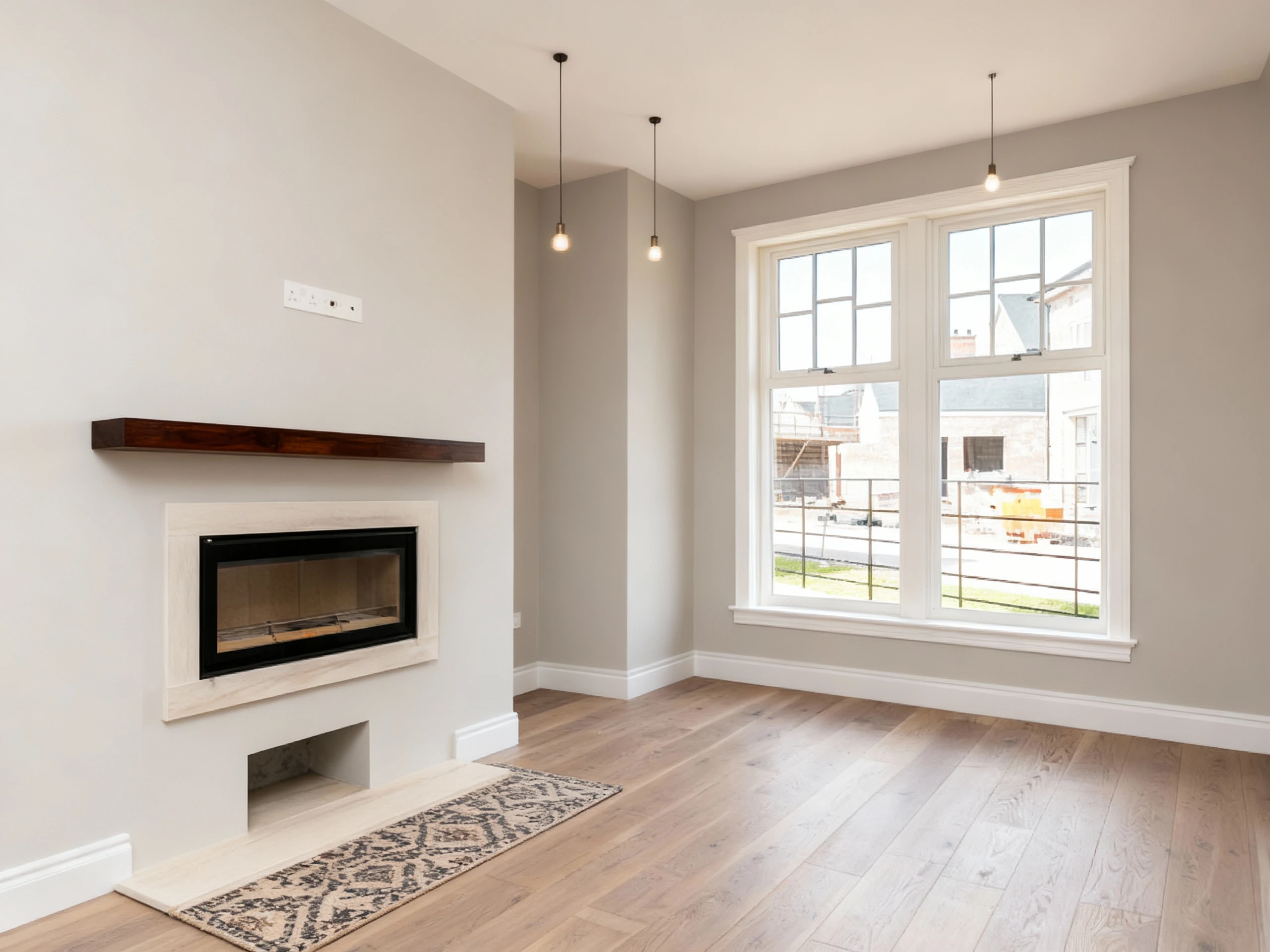
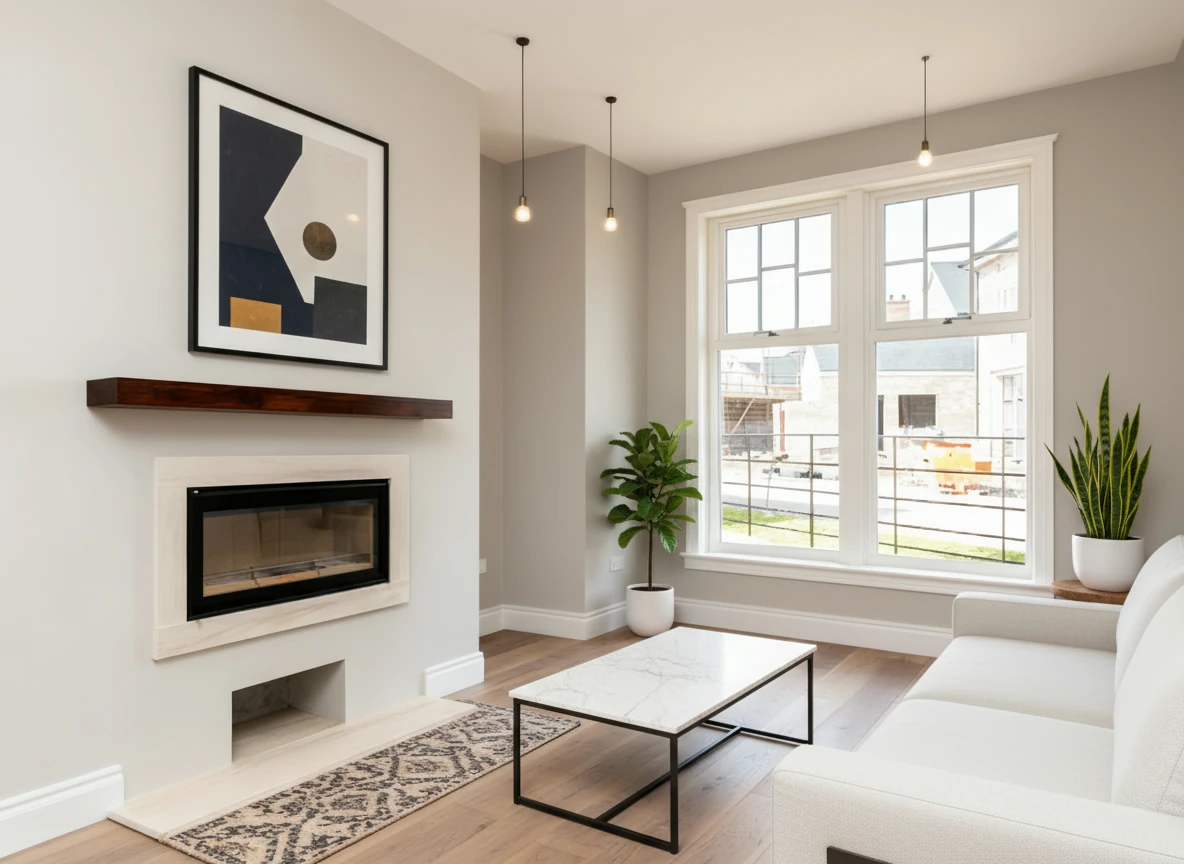
Empty room before virtual staging
Before
After
After

Create a photo of the same living room, virtually staged in a Modern style. Add a sleek white sofa to the right side of the photo, a minimalist coffee table in the center of the room, a large abstract art piece on the main wall, and some indoor plants.


What's the Fundamental Difference?

AI Virtual Staging:

Furniture is added to photos using automated AI in 30-60 seconds. You upload images, select styles, and get instant results. Can regenerate unlimited times at the same low cost. Enables iterative workflow and market responsiveness.

Manual Virtual Staging Services:

Furniture is added to photos by human designers in 48-72 hours. You email images with style brief, wait for delivery, pay extra for revisions. Linear workflow with upfront style commitment.

Physical Staging (Different Market Segment):

Actual furniture moved into property for 30-90 days. Serves in-person showing experience rather than online marketing. Not a direct competitor to virtual staging services—addresses different buyer journey stage.


The Real Comparison: AI vs Manual Virtual Staging

Since 90% of buyers browse listings online before visiting, the virtual staging choice (AI vs manual) determines your workflow capabilities and market responsiveness.

The Core Difference Isn't Just Cost:

Manual virtual staging thinking:

  • Choose a style upfront
  • Commit to that direction
  • Hope it works with buyers
  • Expensive/slow to change if it doesn't

AI virtual staging thinking:

  • Test 3-5 styles immediately
  • See what resonates with market
  • Pivot based on feedback data
  • Respond to buyer signals in real-time

This workflow transformation is why AI virtual staging isn't just "cheaper manual staging"—it's a fundamentally different approach that enables market responsiveness.


Cost & Flexibility Comparison: AI vs Manual Virtual Staging

AI Virtual Staging Costs:

Per-image pricing:

  • Single image: $0.05-$0.30
  • 8-room property: $4-$10
  • 15-room luxury home: $8-$20

Credit pack pricing:

  • Nano: $12 = 150 credits (35-70 images)
  • Mini: $30 = 400 credits (100-200 images)
  • Medium: $100 = 1,400 credits (350-700 images)

Subscription pricing (annual):

  • Basic: $9/month (~100 images)
  • Pro: $19/month (~420 images)
  • Business: $39/month (~840 images)

Effective cost: $0.05-$0.16 per image with volume/subscriptions
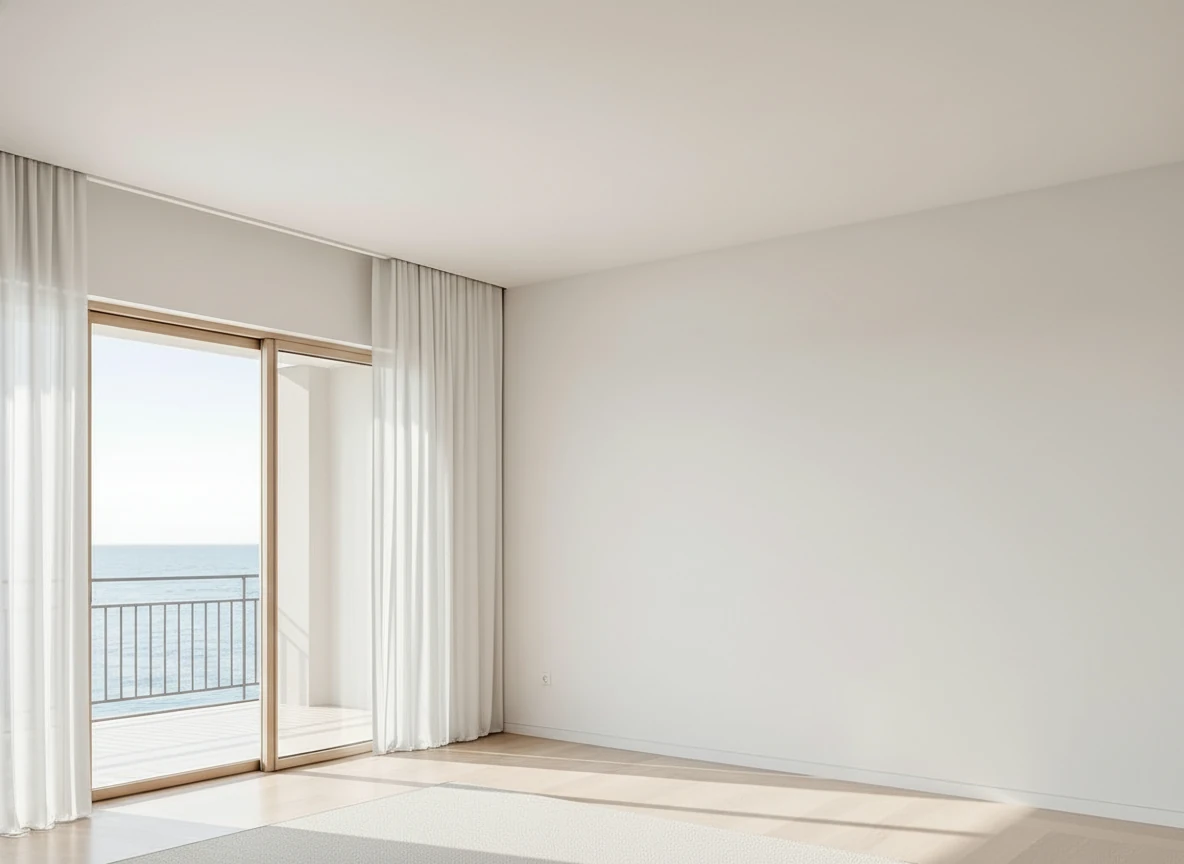
Empty room before virtual staging
Before
After
After

Furnish the serene bedroom with a low-profile cream platform bed centered on a large textured beige rug. Dress the bed in white linens with a soft blue throw and matching accent pillows for contrast. Place a tall potted olive tree in a white planter beside the sliding glass doors, and a small brass bedside lamp on the right. Hang a framed ocean-themed artwork above the bed to echo the seaside view. Keep floor-to-ceiling white curtains along the balcony doors, light wood flooring, and minimal decor to maintain an airy, coastal feel.


Manual Virtual Staging Service Costs:

Per-image pricing:

  • Standard service: $30-$40 per image
  • Rush service: $60-$75 per image
  • Simple edits: $4-$8 per image

Revision costs:

  • First revision: Sometimes included
  • Additional revisions: $15-$25 each
  • Style changes: $20-40 (essentially restart)

8-room property:

  • Initial staging: $240-$320
  • 2-3 revisions: +$45-$75
  • Style pivot (if needed): +$240-$320
  • Total if you need to pivot: $480-$715

The Real Cost Difference: Flexibility

ScenarioAI CostManual CostTime Difference
Initial staging (8 rooms)$4-10$240-3202 min vs 48-72 hrs
Test 3 styles before deciding$12-30$720-9605 min vs 6-9 days
Pivot after week 1 feedback+$4-10+$240-3205 min vs 2-3 days
Total with one pivot$8-20$480-640Same day vs 5-7 days

Key insight: AI doesn't just save money—it enables a workflow where pivoting based on market data is economically feasible. With manual services, you're locked into your initial choice because changing is too expensive and slow.


Physical Staging (For Reference - Different Market):

Note: Physical staging serves in-person showings, not online marketing. It's not a direct competitor but a different service for a different buyer journey stage.

Typical costs:

  • Standard home: $2,000-$5,000 (first month)
  • Luxury home: $5,000-$15,000+
  • Monthly rental: $1,200-$7,000

Use case: High-end properties where in-person showing experience justifies cost. Not suitable for online marketing optimization or rapid market testing.


Workflow & Timeline Comparison

AI Virtual Staging Workflow:

Day 1 - Morning:

  • Photoshoot: 2-3 hours

Day 1 - Afternoon:

  • Upload to platform: 2 minutes
  • Generate style 1 (modern): 30 seconds
  • Generate style 2 (transitional): 30 seconds
  • Generate style 3 (contemporary): 30 seconds
  • Review with team/seller: 30 minutes
  • Refine winning direction: 2 minutes
  • Result: MLS-ready images, 3 styles tested

Day 2: Upload to MLS, monitor performance

Days 3-10: Track showing requests, gather feedback

If needed: Pivot to new style (5 minutes, $4-10)

Total: Same-day staging with built-in flexibility
Empty room before virtual staging
Before
After
After

Furnish the room with a long beige sofa on the left facing a rectangular walnut coffee table (1.6m × 0.8m) centered on a light cream rug. Add two black leather lounge chairs with wooden frames opposite the sofa, one angled toward the windows. Behind, place a low walnut sideboard spanning the width between two tall built-in wood panels, decorated with sculptural vases and a gramophone. Mount a large abstract artwork above the sideboard. Finish with a warm table lamp on the side table near the sofa, soft downlights, and full-height glass doors along the right wall. Make sure the placement of furnitures are reasonable based on the room layout


Manual Virtual Staging Workflow:

Day 1:

  • Photoshoot: 2-3 hours
  • Email to staging service with style brief: 30 minutes
  • Commit to one style (can't test multiple economically)

Days 2-4: Wait for delivery (48-72 hours)

Day 5: Receive images, request revisions if needed (+$15-25 each)

Days 6-8: Wait for revisions (if requested)

Day 9: Upload to MLS

Days 10-17: Monitor performance

If pivot needed: Pay $240-320+ to restage, wait another 3-5 days

Total: 4-8 days minimum, expensive to change course


The Workflow Impact:

FactorAI Virtual StagingManual Virtual Staging
Time to first images5 minutes48-72 hours
Test multiple styles upfrontYes, $4-10 for 3 stylesNo, too expensive ($720-960)
Pivot if underperforming5 minutes, same low cost3-5 days, full price again
Team flexibilityAnyone can generateDepends on designer schedule
Market responsivenessInstantLimited by cost & time
Risk of wrong styleLow (test before commit)High (commit before testing)

The transformation: AI turns staging from a linear bet into an iterative process where you respond to actual market data.


Why Workflow Flexibility Matters More Than Cost

Yes, AI is 99% cheaper. But the real advantage is strategic agility:

Scenario 1: Testing Market Positioning

Agent's challenge: Unsure if property appeals to young professionals or families

With manual services:

  • Choose one demographic upfront
  • Pay $320 to stage for that demographic
  • Hope you guessed right
  • If wrong, either live with poor performance or pay another $320

With AI:

  • Generate both styles ($8 total)
  • Show to colleagues/seller
  • Or test both in market (alternate photos in MLS)
  • Use actual data to decide
  • Pivot immediately based on showing feedback

Value: Not just saving $312, but making data-driven decisions instead of guesses.


Scenario 2: Responding to Broker Feedback

Situation: After 10 days, cooperating brokers say "feels too cold/modern"

With manual services:

  • Pay $240-320 to restage with warmer style
  • Wait 48-72 hours
  • Lose 3-5 more days of marketing time
  • Total cost to pivot: $240-320 + opportunity cost of delays

With AI:

  • Regenerate with "warm transitional" style (2 minutes, $4-8)
  • Update MLS same hour
  • Resume marketing immediately
  • Total cost to pivot: $4-8, zero time delay

Value: Market responsiveness that's economically feasible.


Scenario 3: High-End Custom Look

Luxury listing: Seller wants specific style vision

With manual services:

  • Email detailed brief to designer
  • Pay $60-75 per image for "rush" custom work
  • Wait 24-48 hours
  • If seller doesn't love it: revision fees add up quickly
  • Hesitation to request changes due to cost

With AI:

  • Generate initial interpretation ($8 for 8 rooms)
  • Review with seller same day
  • Iterate with detailed prompts until perfect
  • No penalty for refinement
  • Seller feels heard, involved in process

Value: High-end customization without high-end commitment anxiety.


Scenario 4: Team Coordination

Brokerage with 10 agents:

With manual services:

  • Agents email staging requests
  • Designer schedules work
  • Bottlenecks during busy periods
  • Inconsistent turnaround times
  • Some listings delayed waiting for designer availability

With AI:

  • Every agent generates staging immediately
  • Zero bottlenecks
  • Consistent 2-minute turnaround
  • Designer time reallocated to strategy/training
  • Team responsive to market as one unit

Value: Operational efficiency, no workflow dependencies.


Quality & Realism Comparison

Virtual Staging Quality:

Modern AI virtual staging (2024-2026):

  • ✅ Photorealistic imagery indistinguishable from photos
  • ✅ Accurate shadows, lighting, and perspective
  • ✅ Proper furniture scaling and placement
  • ✅ Multiple style options at no extra cost
  • ⚠️ Requires clear disclosure to buyers
  • ⚠️ Property still shows empty during tours

Quality factors:

  • AI quality has reached professional photography standards
  • Properly executed virtual staging looks identical to physical staging in photos
  • The question isn't "which looks better" but "which experience matters more"
Empty room before virtual staging
Before
After
After

Furnish the bedroom with a bed and additional furniture and decorations, and create a 2x2 image showing four variations of the same coastal bedroom in different interior design styles. Use consistent room layout and lighting, but vary textures, furniture, and decor to reflect each style. The four styles are: 1. Modern Coastal – light oak wood, white linen bedding, minimal decor, ocean-inspired art. 2. Bohemian Coastal – rattan furniture, layered textiles, soft blue-green palette, plants and woven accents. 3. Luxury Coastal – high-end finishes, soft beige and ivory tones, marble nightstands, large windows with seaside view. 4. Rustic Beach Cottage – weathered wood furniture, nautical elements, striped bedding, casual cozy feel. Include natural daylight, soft shadows, and an airy seaside atmosphere. Keep the room window/building structure unchanged in all variations


Physical Staging Quality:

Professional physical staging:

  • ✅ Tangible in-person experience
  • ✅ Buyers can sit on furniture, open doors
  • ✅ Creates emotional connection during showings
  • ✅ No disclosure required beyond standard "Staged" notice
  • ⚠️ Limited style flexibility once installed
  • ⚠️ Photography quality varies by photographer skill

Quality factors:

  • Staging quality varies dramatically by company
  • In-person experience can create stronger emotional responses
  • Furniture must be appropriate for the space (size, style, wear)

ROI Beyond Just Cost Savings

Both AI & Manual Virtual Staging Drive Sales Results:

Industry data (Real Estate Staging Association):

  • Staged homes sell 73% faster than unstaged
  • Staged homes sell for 5-10% more on average
  • 90% of buyers start their search online
  • 47% of buyers say staged homes are easier to visualize

Key insight: The ROI advantage isn't AI vs manual (both improve sales)—it's that AI's low cost enables strategic flexibility impossible with manual services.


Traditional ROI Calculation (Cost Savings):

AI Virtual Staging:

  • Investment: $4-10 per listing
  • Price increase: 5-10% ($20,000-$40,000 on $400K home)
  • ROI: 200,000% to 1,000,000%

Manual Virtual Staging:

  • Investment: $240-320 per listing
  • Price increase: 5-10% (same)
  • ROI: 6,250% to 16,667%

Yes, AI delivers better ROI—but that's not the main story.


The Real ROI: Strategic Flexibility

Flexibility ROI Example:

Scenario: $450,000 listing, staged with manual service for $280

Week 1-2: 25 online views, 1 showing, no offers
Broker feedback: "Style feels off for the neighborhood"

Option A (Manual service): Live with poor performance or pay another $280 + wait 3-5 days
Option B (AI): Pivot to different style for $6, update MLS same day

Outcome with AI pivot:

  • Week 3-4: New style resonates, 40 views, 6 showings, 2 offers
  • Sells for $465,000 (3% premium from competitive offers)
  • Flexibility value: $15,000 additional sale price from responsive strategy

The insight: AI's low cost makes pivoting economically rational. Manual services' high cost forces you to "hope" your initial choice works—even when data suggests it doesn't.


Flexibility ROI in Practice:

SituationManual ResponseAI ResponseValue Difference
Test 3 buyer demographicsImpossible ($960)Easy ($12)$948 + better targeting
Pivot after week 1 feedbackExpensive ($280+)Trivial ($6)$274 + faster sale
Custom look iterationRevision fees pile upSame price$50-150 + seller satisfaction
High-volume efficiencyDesigner bottlenecksInstant availabilityTime = money

The compound effect: Over 10 listings, the ability to test and pivot saves $5,000-10,000 while also improving average sale prices through better market alignment.


Physical Staging (Reference Point):

Different market segment: Physical staging ($2,000-$5,000) serves in-person experiences, not online marketing optimization. ROI is 172% to 1,900% but addresses different buyer journey stage.

When it makes sense: Luxury properties ($1M+) with high showing volume where tangible experience justifies cost.


When to Choose AI vs Manual Virtual Staging

AI Virtual Staging Is Ideal For:

Market testing – Want to try multiple styles before committing
Responsive agents – Need ability to pivot based on feedback
High-volume operations – Processing 5+ listings monthly
Budget-conscious – Every dollar counts
Fast timelines – Need staging same day as photos
Team environments – Multiple agents need instant access
Data-driven strategy – Want to A/B test styles
Uncertain markets – Not sure what will resonate
Iterative high-end – Luxury clients who want to refine vision
95% of all listings – Where workflow flexibility matters
Empty room before virtual staging
Before
After
After

Furnish the dining area with a long natural oak dining table (3m × 1m) centered on the wooden floor, surrounded by eight matching curved-back oak chairs. Above the table, install a pair of minimalist black-and-white pendant lights aligned along the centerline. Add sheer white curtains across the full window wall for soft daylight diffusion. Place a slim black console with potted plants and small decor on the left wall, and keep the adjoining kitchen open with white cabinetry and oak shelving for a warm, cohesive look.


Manual Virtual Staging Makes Sense For:

⚠️ Highly specific custom work – Very unique artistic vision that requires human consultation
⚠️ Complex compositing – Multiple images merged into one scene
⚠️ Architectural visualization – Technical accuracy over speed
⚠️ One-off prestige projects – Where designer relationship is valued

Reality: For 95%+ of listings, AI delivers equivalent or better quality with dramatically better workflow. Manual services made sense when they were the only option—AI has fundamentally changed the equation.


Physical Staging (Different Market Segment):

Use physical staging for: In-person showing impact at luxury price points ($1M+)

Use virtual staging (AI or manual) for: Online marketing optimization across all price ranges

These serve different purposes and aren't directly comparable—one addresses photos, one addresses in-person experience.


Hybrid Approach: Best of Both Worlds

Many successful agents use both methods strategically:

Strategy 1: Virtual First, Physical If Needed

  1. Week 1-4: List with virtual staging
  2. Monitor metrics: Showings, online interest, feedback
  3. If underperforming: Add physical staging for showing boost
  4. Outcome: Save $2,000-4,000 if property sells quickly with virtual only

Success rate: 70% of properties sell with virtual staging alone.

Strategy 2: Physical for Showings, Virtual for Online

  1. Physically stage main living areas only (living room, master bedroom)
  2. Virtually stage all other rooms in photos
  3. Result: Full marketing presence at 40-60% of full staging cost

Cost savings: $1,000-$2,500 vs full physical staging.

Strategy 3: Virtual for Volume, Physical for Flagship

For high-volume teams:

  • Virtual staging: All listings under $750K
  • Physical staging: Listings over $750K or luxury properties
  • Result: Optimized cost structure across entire portfolio

Buyer Perception & Disclosure

Virtual Staging Buyer Perception:

Research findings:

  • 87% of buyers find virtually staged photos helpful
  • 92% of buyers are comfortable with virtual staging when disclosed
  • Only 11% report feeling misled (when properly disclosed)
  • 78% of agents report no negative feedback from buyers

Disclosure best practices:

  • Clear "Virtually Staged" captions
  • Include both staged and unstaged photos
  • Mention in listing description
  • Explain during showings
  • Some agents bring printed staged photos to showings
Empty room before virtual staging
Before
After
After

Furnish the study with a mid-century wooden desk centered in front of tall, cream-draped windows, paired with a blue-upholstered chair featuring metal legs. Place a vintage desk lamp and neatly arranged books and stationery on the desk. To the left, add a red open bookshelf filled with books and decorative objects. Include a tall arched chrome floor lamp curving over the desk for dramatic lighting. Hang two framed figure drawings symmetrically on either side of the window. Keep the ornate white paneled walls and chevron wood floor exposed for a refined Parisian atmosphere.


Physical Staging Buyer Perception:

Research findings:

  • 93% of buyers find staged homes easier to visualize
  • 82% of buyers can better imagine themselves living there
  • 40% of buyers say staging influenced their purchase decision
  • 48% of buyers make offers on first visit to staged homes

Considerations:

  • No disclosure concerns beyond standard "Staged"
  • Buyers experience the space as presented in photos
  • Furniture quality affects perception of property maintenance
  • Some buyers struggle to see past the staging style

Decision Framework: Which Should You Choose?

Use this framework to decide:

Step 1: Assess Property Value

Under $300K: Virtual staging (97% of listings)
$300K-$600K: Virtual staging primary, physical for luxury exceptions
$600K-$1M: Either works; decide based on competition
$1M-$2M: Physical staging unless tight timeline
$2M+: Physical staging standard in luxury markets

Step 2: Evaluate Timeline

Need to list within 1 week: Virtual staging only option
2-3 weeks available: Virtual staging recommended
4+ weeks available: Either option viable
Extended timeline expected: Physical staging ROI improves with time

Step 3: Consider Market Dynamics

Hot market (under 30 days average): Virtual sufficient
Balanced market (30-60 days average): Either works
Slow market (60+ days average): Physical staging adds showing value

Step 4: Analyze Competition

Most listings unstaged: Virtual staging provides major advantage
Mix of staged/unstaged: Match or exceed staging standards
All competing listings staged: Physical staging to match premium positioning

Step 5: Calculate Budget

Budget under $500: Virtual staging only option
Budget $500-$2,000: Virtual staging optimal
Budget $2,000-$5,000: Physical staging for targeted properties
Budget $5,000+: Physical staging for luxury experience


Common Questions: Virtual vs Physical

Can I do both?

Yes, and many agents do. Start with virtual staging for online marketing, then add physical staging if the property isn't attracting expected showing volume. This "staged approach" (pun intended) optimizes spending.

Does virtual staging hurt credibility?

Not when properly disclosed. Studies show 92% of buyers appreciate virtually staged photos when they're clearly labeled. The key is transparency—never hide that staging is virtual.

Which one actually sells homes faster?

Both work. Staged homes (virtual or physical) sell 73% faster than unstaged. The choice between them is about cost optimization and market positioning, not speed of sale.

Can virtual staging replace physical for luxury homes?

Usually not. Luxury buyers expect in-person experiences that match photo marketing. Virtual staging works as a supplement or interim solution, but physical staging remains standard in luxury markets.

What if buyers are disappointed at showings?

This is the main risk of virtual staging. Manage it by:

  • Clear disclosure in all marketing
  • Including unstaged photos in gallery
  • Setting expectations via email/phone before showing
  • Focusing on the space's potential, not current emptiness

Can I try one then switch to the other?

Absolutely. Many agents start with virtual staging ($5-30), then add physical staging ($2,000-5,000) if needed after 30 days. This staged rollout minimizes risk while keeping options open.


Real-World Cost Scenarios

Scenario 1: Typical 3BR Suburban Home ($425,000)

Virtual staging approach:

  • Cost: $20 (8 rooms)
  • Timeline: 2 days to list
  • Result: Sold in 32 days
  • Total cost: $20

Physical staging approach:

  • Cost: $3,200 (initial) + $1,200 (month 2)
  • Timeline: 14 days to list
  • Result: Sold in 38 days
  • Total cost: $4,400

Savings with virtual: $4,380


Scenario 2: Luxury 5BR Estate ($1.8M)

Virtual staging approach:

  • Cost: $45 (15 rooms)
  • Timeline: 2 days to list
  • Result: 12 showings, no offers in 60 days
  • Added physical staging: $8,500
  • Total cost: $8,545, sold day 68

Physical staging approach:

  • Cost: $8,500 (initial) + $2,500 (month 2) + $2,500 (month 3)
  • Timeline: 18 days to list
  • Result: Sold in 58 days
  • Total cost: $13,500

Savings with hybrid: $4,955


Scenario 3: Investment Flip ($245,000)

Virtual staging approach:

  • Cost: $15 (6 rooms)
  • Timeline: 1 day to list
  • Result: Sold in 18 days
  • Total cost: $15

Physical staging approach:

  • Cost: $2,400 (initial)
  • Timeline: 12 days to list
  • Result: Sold in 24 days
  • Total cost: $2,400

Savings with virtual: $2,385 + 11 days faster to market


AI Virtual Staging Improvements (2024-2026):

  • Photorealism: Indistinguishable from real photography
  • Customization: Text-prompt control over every detail
  • Speed: Real-time generation (under 30 seconds)
  • Cost: Approaching $0.05 per image with AI efficiency
  • Variations: Unlimited style testing at no extra cost

Emerging Hybrid Technologies:

  • 3D virtual tours with staged views
  • AR staging allowing buyers to see furnished rooms via smartphone
  • Virtual reality showing experiences before visiting
  • 360° virtually staged panoramas

Trend: The gap between virtual and physical staging experiences continues to narrow.


Making Your Decision: It's About Workflow, Not Just Cost

For 95% of listings, AI virtual staging is the clear choice:

  • Not because it's "cheaper" (though it is—99% less than manual)
  • But because workflow flexibility enables market responsiveness
  • Test styles, pivot based on data, iterate without penalty
  • Turn staging from a one-time bet into a responsive strategy

Manual virtual staging made sense when it was the only option:

  • Now it's hard to justify the cost and workflow limitations
  • Unless you need highly specialized custom work
  • AI delivers equivalent quality with dramatically better flexibility

Physical staging serves a different purpose:

  • In-person showing experience, not online marketing
  • Luxury properties ($1M+) where buyers expect it
  • Not a competitor to virtual staging—addresses different buyer journey stage

The transformation: AI virtual staging isn't "cheaper manual staging"—it's a workflow revolution that enables data-driven, responsive real estate marketing impossible with traditional services.


Final Comparison Summary

FactorAI Virtual StagingManual Virtual StagingPhysical Staging
PurposeOnline marketingOnline marketingIn-person showings
Cost$0.05-$0.30/image$30-$75/image$2,000-$5,000/property
Turnaround30-60 seconds48-72 hours2-3 weeks
WorkflowIterative, responsiveLinear, committedOne-time setup
Style testingEasy ($5 for 5 styles)Expensive ($750 for 5 styles)N/A
Pivot capabilityInstant, same costSlow, full cost againVery difficult
Best for95% of listingsNiche custom workLuxury in-person

Bottom line: AI virtual staging enables a workflow that was impossible before—where staging becomes a responsive marketing tool, not a hope-and-pray commitment.


Next Steps: Experience the Workflow Difference

Ready to stage your next listing? Try StagerGo's AI virtual staging below:

  1. Upload your photos
  2. Generate 3-5 different styles in 5 minutes
  3. See which resonates
  4. Iterate based on feedback
  5. Respond to market in real-time

This is what workflow transformation looks like.